fechar
BLOG

Shopping choice drivers are weirdly similar around the world (until they’re not) 

Mark Miller
Experiência com o produto

Article 3 of 5 in the State of Product Experience 2026 Collection 

For the 2026 State of Product Experience report, Syndigo surveyed 8,736 adults across Australia, Brazil, France, Germany, the UK, and the US. The research asked what helps shoppers choose, what makes them leave, how product information shapes brand perception and loyalty, and where AI is beginning to enter the journey. 

The broad patterns are surprisingly consistent. Shoppers everywhere want enough information to understand a product, compare it, and feel confident that what arrives will match what they saw. But the closer you look, the more each market reveals its own formula for getting chosen.  

We broke out the individual country results into market-specific reports; here are the highlights and links to the complete research for each region. 

First, the part shoppers agree on 

Across all six markets, 83% of online shoppers said they are likely to move to another site or app when product information is insufficient. Four in five said inaccurate or incomplete online representation hurts their perception of a brand. And 72% of adults said quickly finding all the information they want makes them at least a little more likely to turn to that brand or retailer first for a similar purchase. 

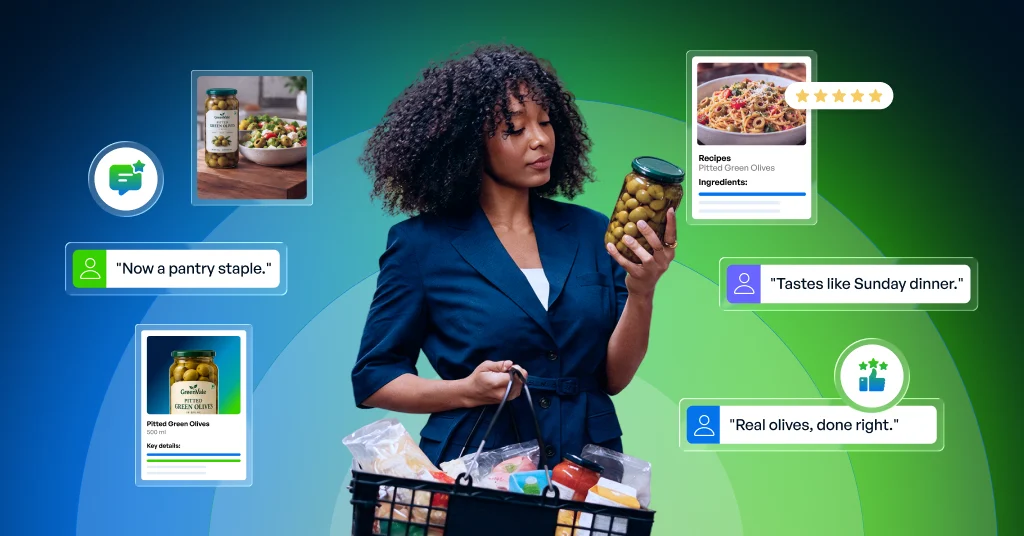
The ingredients of confidence also travel well. Ratings and reviews were a top-three online purchase consideration for 53% of shoppers, closely followed by detailed descriptions at 52% and discounts or deals at 49%. AI recommendations, by comparison, were selected by 8%. 

So the global story is not that every shopper behaves the same. It is that the same basic bargain holds almost everywhere: give people clear, credible information and they are more willing to choose you; leave gaps, and they are willing to leave. The differences show up in which signals matter most, how shoppers respond when content fails, and how much room they are willing to give AI. 

Australia: AI-curious, but still seeing the content cracks 

Australian shoppers appear relatively open to AI compared to counterparts around the world, though they’re not overlooking the fundamentals. 44% of online shoppers trust product information provided by AI, slightly above the 40% global average, and 24% say an AI recommendation would make them more likely to buy. Yet Australia also reports more visible content friction: 24% of shoppers recently saw a product appear differently in-store than it did online, and the same share encountered inconsistent or contradictory information, versus 15% and 17% globally. 

Click here to download The State of Product Experience 2026: Australia Edition 

Brazil: AI has already earned a seat at the table 

Brazil is the clearest AI-forward market in the research. Seventy-one percent of online shoppers trust product information supplied by AI, compared with 40% globally, and 52% say an AI recommendation would make them more likely to buy, more than double the global rate.  

Product information also has an unusually strong loyalty effect: 92% of Brazilian adults say quickly finding everything they want would make them more likely to turn to that brand or store first. 

Click here to download The State of Product Experience 2026: Brazil Edition 

France: Fewer reported problems, and more willingness to experiment 

France reports the smoothest recent product experience of the European markets surveyed: 39% of shoppers said they had experienced none of the listed content-related problems, compared with 33% across Europe and 29% globally.  

French shoppers are also the most AI-curious of the three European markets. Forty percent trust AI-provided product information, ahead of Germany at 38% and the UK at 28%. 

Click here to download The Product Experience Cup 2026: France Edition 

Germany: Make the value clear (and set expectations accurately) 

German shoppers put the sharpest pressure on value. Fifty-seven percent name discounts or deals as a top-three purchase consideration, versus 50% across Europe and 49% globally.  

At the same time, 30% recently returned a product because it did not meet expectations based on the information available while shopping—the highest rate among the three European markets. In Germany, strong content needs to do more than describe the product; it has to explain the value and set the right expectation. 

Click here to download The Product Experience Cup 2026: Germany Edition 

United Kingdom: Proof carries the cart 

UK shoppers are the most evidence-driven audience in Europe. Ratings and reviews are a top-three consideration for 60% of online shoppers, while detailed descriptions reach 58%.  

They are also the quickest to expose a content gap: 43% recently abandoned a purchase because they could not find enough information, compared with 25% in both France and Germany. That insistence on proof comes with more AI skepticism, too; only 28% trust AI-provided product information. 

Click here to download The Product Experience Cup 2026: UK Edition 

United States: High expectations—and the highest disappointment rate 

US shoppers combine strong demand for traditional decision signals with unusually visible post-purchase consequences. Sixty-two percent of online shoppers name ratings and reviews as a top-three consideration, the highest of the six markets, while 57% select discounts or deals and 56% select detailed descriptions. Forty percent of US shoppers recently said a purchase failed to meet expectations based on information they had read online, and 31% returned a product because it did not meet expectations based on the information available while shopping—the highest rates in the study on both measures. 

The US is more cautious about AI than Brazil or Australia, but not closed to it. Thirty-five percent of online shoppers trust AI-provided product information, 19% say an AI recommendation would make them more likely to buy, and 69% say they have never and would never let an AI agent purchase on their behalf. 

Click here to download The Product Experience 2026 

Global consistency does not mean a one-size-fits-all experience 

The shared foundation is clear: accurate information, detailed descriptions, reviews, and realistic expectations matter in every market. The opportunity is to build that foundation once, then tune the experience to what each audience is telling you. 

In Australia, that means closing visible consistency gaps while preparing for growing AI influence. In Brazil, it means making structured content ready for an audience already receptive to AI assistance. France rewards a smooth overall experience. Germany asks content to make the value case and prevent mismatched expectations. The UK wants proof in depth. And the US shows how quickly weak expectation-setting can turn into disappointment and returns. 

Previously in this collection: Your incomplete product data keeps showing up as someone else’s problem. 

Next in the collection: Step aside, discounts: Reviews are the new leading purchase trigger

See what shoppers expect from every product experience.

Download The State of Product Experience 2026.