

Every major shift in commerce has had an infrastructure problem before it had a strategy problem.
ATMs needed years of infrastructure work (networks, security, standards) before they could do more than dispense cash. E-commerce needed a decade of payment infrastructure, logistics networks and search algorithms to become the channel it is today. The strategy always arrives before the infrastructure is ready for it, and the companies that get there first are usually the ones who built the plumbing while everyone else was still debating the vision.
I think agentic commerce is in exactly that gap right now. The stakes are enormous: McKinsey estimates AI agents could orchestrate $3 trillion to $5 trillion in global retail sales by 2030, including as much as $1 trillion in the U.S. alone. Every company has a point of view on how AI will change shopping. Very few have the infrastructure to make that vision real. As I’ve said before, AI shopping agents are surprisingly risk-averse: they won’t recommend a product they can’t fully verify. So the real constraint on agentic commerce is whether the data underneath it is complete, accurate and trustworthy enough for an AI to act on with confidence.
That’s the infrastructure problem our teams have spent decades solving: the product data, the two-sided network connecting brands and retailers, and the trust signals that tell an AI assistant a product is real and reliable. Microsoft has been solving a parallel infrastructure problem: the cloud and AI capabilities enterprises need to put AI to work at scale.
Agentic commerce describes what shoppers’ AI agents do. Frontier Commerce describes what brands and retailers do to be ready for it: using AI to amplify the product intelligence they already own and put it to work on every shelf, in stores, online and in AI shopping experiences. That means AI running the work behind every product, from content and workflows to pricing and payment systems, as well as the experiences where shoppers decide. Microsoft calls this kind of change Frontier Transformation. Frontier Commerce is what it looks like in commerce, and every part of it runs on product data. An AI workflow built on bad data just makes mistakes faster.
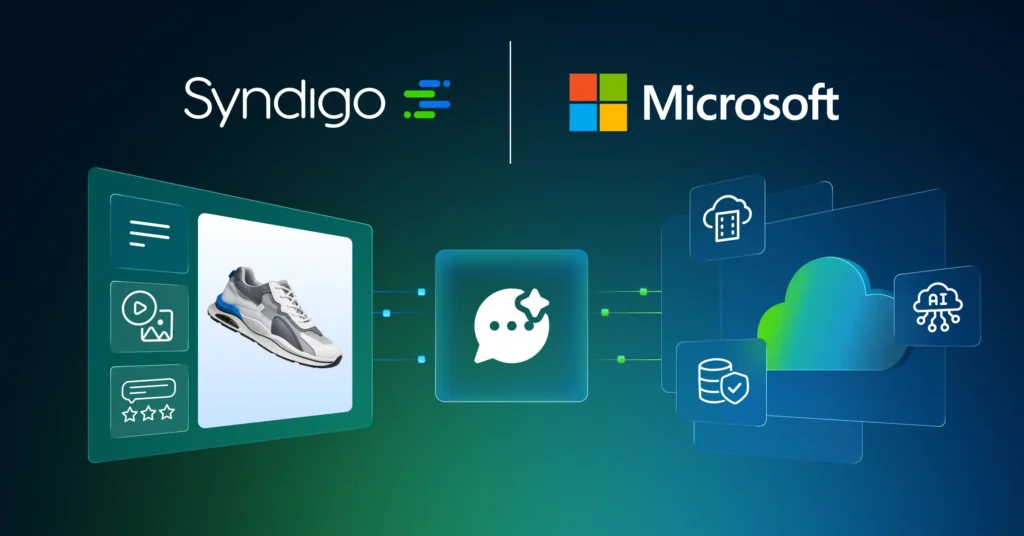
That’s why Syndigo and Microsoft signed a multiyear strategic partnership to build AI-powered commerce solutions and take them to market together, with Syndigo as a Microsoft Global ISV partner.
We’re holding ourselves to the same standard. Syndigo is adopting Microsoft 365 E7 to put Copilot and Agent 365 to work across our teams, from product and engineering to go-to-market. We can’t ask customers to run on AI if we aren’t doing it ourselves.
For brands and retailers, the implication is concrete. AI shopping assistants run on the same trust signals as human shoppers: structured, accurate, consistent product information, backed by real reviews. The companies that act on that ahead of their competitors are the ones that will get chosen as more of the first pass of shopping moves to AI. The infrastructure question isn’t someone else’s problem to solve before you show up. It determines whether you show up at all.
We’re still early in Frontier Commerce. But I’d rather be building the infrastructure now, while most of the market is still debating the strategy, than catching up later.