


Cyber Monday 2025: What’s Different This Year?
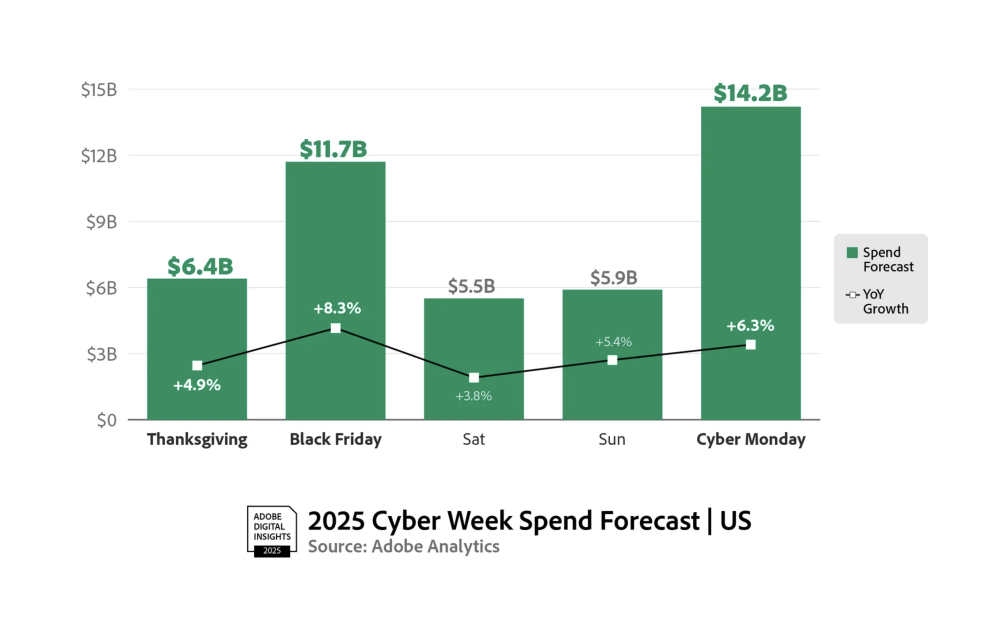
Cyber Monday has long been the crown jewel of holiday e-commerce, but 2025 marks a turning point. U.S. online holiday sales are projected to reach $253.4 billion, with Cyber Monday alone expected to hit $14.2 billion, a 6.3% year-over-year increase. Mobile is expected to dominate, now accounting for more than half of all online purchases.
But the real story isn’t just about numbers—it’s about how shoppers are finding and buying products. According to research in Syndigo’s 2025 Omnichannel Shopping Benchmarks report, 45% of shoppers have recently used AI tools like ChatGPT or Google Gemini for product discovery and deal-hunting; up 23 points over just two years. And AI-driven agents are expected to influence $73 billion in global Cyber Week sales, up 22% from last year.
Download The 2025 Omnichannel Shopping Benchmarks Report
For brands and retailers, this shift signals a new reality: the digital shelf is no longer confined to product detail pages (PDPs) and search results. It’s expanding into conversational interfaces, AI-powered recommendations, and autonomous shopping agents.
The Future of E-Commerce and the New Digital Shelf
The traditional e-commerce flow (search → PDP → checkout) is being disrupted.
Today, consumers can start and finish their shopping journey inside a chat interface. Platforms like ChatGPT now enable direct purchases through integrations with Etsy and Shopify, powered by OpenAI’s Agentic Commerce Protocol (ACP). Other retailers are embedding AI assistants into their own ecosystems, offering personalized recommendations and streamlined checkout experiences.
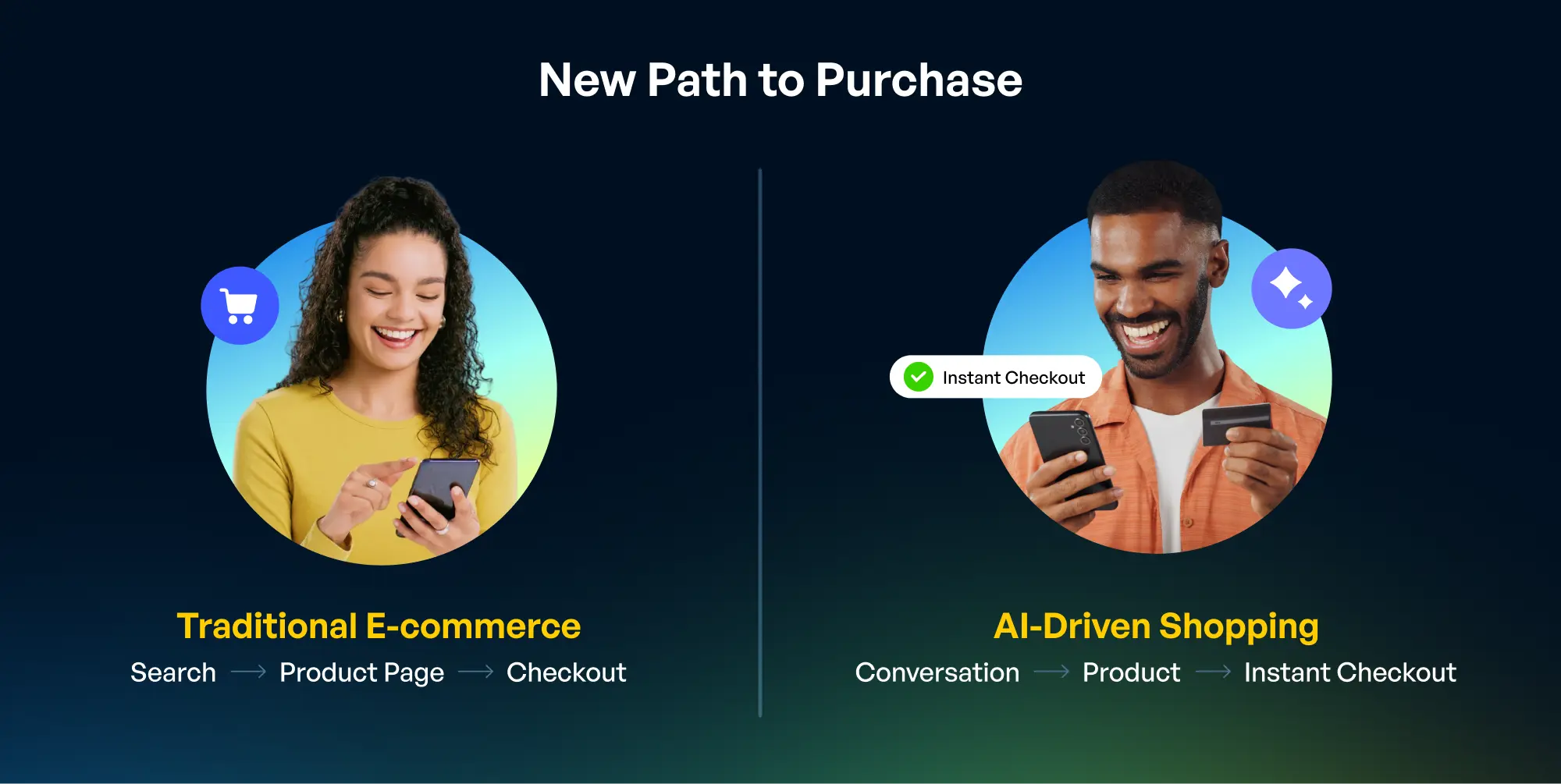
This evolution introduces agentic commerce, where AI agents act autonomously to discover, compare, and even purchase products on behalf of consumers. By 2030, analysts predict that 20% of all transactions will be executed through AI agents. The online point of sale is no longer confined to a PDP or digital cart checkout: it’s wherever the AI conversation happens.
How AI Is Reshaping Discovery and Decision Making
Generative AI tools don’t rely on keyword-based search in the way conventional search engine crawlers have. They prioritize contextual relevance, delivering curated answers instead of endless lists. This shift renders traditional SEO tactics like keyword chasing largely obsolete. Instead, AI systems favor structured, trustworthy, machine-readable data.
Enter GEO (Generative Engine Optimization). GEO is the next frontier for product visibility, focusing on optimizing product data for AI-driven answer engines like ChatGPT and Google’s AI Overviews. Structured attributes, schema markup, and authoritative content are now critical for ensuring your products appear in AI-generated recommendations.
Getting Ahead at the New Point of Sale
AI agents and consumers share the same priorities: reliable, consistent, comprehensive information that’s easy to access. Large language models (LLMs) parse available data to learn about products, and they favor brands that provide validated, machine-readable content.
To succeed in this new environment, brands must:
- Audit product data for accuracy and completeness.
- Implement GEO strategies, including structured data and conversational content.
- Syndicate rich media—images, videos, 360° views—and user-generated content like ratings and reviews.
The Next Cyber Monday: A Glimpse Into 2026
If current trends continue, Cyber Monday 2026 will be dominated by AI-driven shopping experiences. Consumers will increasingly rely on conversational agents to discover, compare, and purchase products—often bypassing traditional e-commerce sites entirely. Brands that fail to adapt risk becoming invisible in AI-driven discovery environments.

Actionable Steps to Prepare for the Era of Agentic Commerce
1. Create an Abundance of High-Quality Content
Why it matters: AI agents and consumers alike rely on rich, accurate, and engaging product content to make decisions. In an environment where conversational interfaces replace traditional search, your product’s visibility depends on the depth and breadth of its content. Treat content creation as a continuous process, not a one-time upload. Refresh seasonal messaging, update imagery, and monitor gaps regularly.
What to do:
- Go beyond basic specs: Include lifestyle imagery, videos, 360° spins, and contextual descriptions that answer real shopper questions.
- Cover every channel: Syndicate content across retailer sites, marketplaces, social platforms, and emerging conversational commerce channels.
- Think omnichannel consistency: Ensure product data is uniform across all touchpoints—discrepancies erode trust and confuse AI models.
- Leverage UGC: Ratings, reviews, and Q&A sections are powerful signals for both consumers and AI systems. Encourage and manage these actively.
2. Engage in GEO (Generative Engine Optimization)
Why it matters: Traditional SEO is losing ground as AI-driven answer engines prioritize structured, machine-readable data over keyword density. GEO ensures your products are discoverable in AI-generated responses. GEO isn’t just technical; it’s strategic. Align your product storytelling with conversational queries AI agents are likely to receive (e.g., “best eco-friendly detergent for sensitive skin”).
What to do:
- Structure your data: Use schema markup, standardized attributes, and taxonomies that AI can parse easily.
- Optimize multimedia for AI: Include alt text, captions, and metadata for images and videos to help LLMs interpret visual content.
- Build authoritative content: AI favors sources with credibility. Publish detailed guides, FAQs, and educational resources tied to your products.
- Monitor AI search trends: Track how generative engines surface products and adapt your content strategy accordingly.
3. Deliver Product Content Directly to LLMs
Why it matters: As platforms like ChatGPT introduce Agentic Commerce Protocol (ACP), brands can bypass traditional e-commerce flows and feed product data directly into AI ecosystems. This ensures your products are available at the new point of sale: inside the conversation.
Think of LLMs as a new distribution channel. Just as you syndicate content to retailers today, you’ll syndicate to AI platforms tomorrow.
What to do:
- Explore emerging protocols: ACP and similar standards allow structured product data delivery to LLMs. Stay informed and integrate early.
- Prioritize machine-readable formats: JSON-LD, APIs, and validated feeds will become essential for AI ingestion.
- Collaborate with tech partners: Work with solution providers (like Syndigo) to ensure compliance and readiness for these integrations.
- Plan for governance: Direct data delivery requires strict quality control; errors can propagate quickly in AI-driven environments. Leverage Product Information Management to manage and govern data at scale.
Accessible Solutions for Agentic Commerce
Syndigo has been a leader in enabling AI-ready product experiences, helping brands deliver structured, validated, and syndication-ready data across every channel—including emerging agentic commerce platforms.
Ready to future-proof your digital shelf?