


For years, digital commerce has been built around a simple assumption: humans search, humans browse, humans compare, and humans decide.
Product experiences were designed accordingly: product pages optimized for shoppers, workflows optimized for teams, systems optimized for execution.
That assumption is no longer holding.
Consumer-facing AI agents are rapidly moving from answering questions to taking action. They are beginning to search, evaluate, compare, recommend, and even transact on behalf of consumers and businesses. As this shift accelerates, it’s changing not just how people shop, but how commerce itself operates.
And it’s exposing a growing gap: most product systems were never designed for a world where machines, not humans, are the primary decision-makers.
The Rise of Agentic Commerce

Much of the recent conversation around AI in commerce has focused on interfaces — chatbots, copilots, and conversational shopping experiences. But the more consequential shift is happening behind the scenes. It’s far less visible, but ultimately more disruptive, since it demands from the systems that power commerce operations. Agentic commerce describes a world where AI systems don’t just assist humans, but act autonomously within defined goals and constraints. These agents can interpret product information, assess tradeoffs, and take action across the entirety of the traditional buyer journey, from discovery and deal-shopping to comparison and transaction and even post-purchase support.
In practice, this means:
- Shoppers may rely on agents to shortlist products, compare attributes, and make recommendations.
- Merchants may rely on agents to optimize assortments, enrich content, and adapt experiences dynamically.
- Decisions increasingly happen system-to-system, not person-to-screen.
- Traditional channels that brands and retailers could directly control, like product detail pages and store shelves, may get completely bypassed by AI interfaces that are out of their hands.
This isn’t a distant future scenario. Early versions of agent-mediated shopping and merchandising are already emerging, and they will only become more capable over time.
Retailers are deploying first-party shopping agents.
Amazon’s AI shopping assistant, Rufus, has evolved from a Q&A chatbot into an agent capable of tracking prices, automatically purchasing items when conditions are met, and even buying products from third party sites on a customer’s behalf through its “Buy for Me” feature. Walmart is taking a similar path with Sparky, its own agent designed to move the shopping experience toward intent-driven commerce by helping shoppers plan meals, events, or projects and then assembling carts automatically.
Other major platforms and retailers like Target, eBay, Kroger, and Instacart have already piloted or announced plans for similar agent-driven shopping experiences, while commerce platforms such as Shopify are rearchitecting checkout and product data for AI-mediated transactions. As they pave the way, expect for others to follow suit.
AI platforms are becoming transactional, not just informational.
OpenAI’s ChatGPT has begun piloting direct, in-chat purchases through its Instant Checkout feature, starting with Etsy and expanding to Shopify merchants and Walmart/Sam’s Club. In these flows, the entire journey, from discovery to payment happens inside the AI conversation.
Google is moving in a similar direction, introducing its Universal Commerce Protocol to allow Gemini and AI-powered Search experiences to recommend and complete purchases directly within Google’s interfaces.
Universal Commerce Protocol and the new rules of AI shopping
Perplexity has also moved beyond research into transactions. In late 2025, the AI answer engine launched Instant Buy, a native in‑chat checkout experience powered by PayPal that allows U.S. users to move from product research to purchase without leaving the conversation
Not Just Another Channel
Commerce has adapted to new channels before: mobile, marketplaces, social, voice. Each of them required changes to content formats, workflows, and distribution models. But agentic commerce is different; it’s not following the same rules.
Unlike previous shifts, AI agents don’t just consume content — they interpret it, reason over it, and act on it. That fundamentally changes the role product data plays in commerce.
Product becomes data less of a passive resource to display and more of an active, living asset that could activate in countless ways. This shifts product experience management (PXM) from a publishing function into an operational one, where product information becomes an input to automated decisions, not just an output to downstream channels. The Product Systems Problem Hiding in Plain Sight
Most brands and retailers already feel pressure around Product Experience Management.
Fragmented product data spread across systems, manual enrichment and exception handling, inconsistencies across channels, and archaic governance models throw up obstacles at every turn.
But these challenges become more acute in an agentic world. Traditional PIM and PXM platforms were designed for human-driven workflows, around isolated domains and linear processes. In an agentic world, where decisions depend on connected product, supplier, compliance, and performance signals, that fragmentation becomes a hard ceiling on progress. That model doesn’t scale when decisions need to happen continuously, in real time, and across thousands or even millions of proliferating SKUs. Consumer brands are often forced to focus their limited resources managing a handful of flagship items while the rest of their catalog gets underserved. Retailers constantly struggle to get the up-to-date, compliant data from broad, diverse supplier communities they need to build a compelling customer experience.
And when AI agents are expected to act on product information, the limitations of legacy approaches become even more clear. Systems built for manual execution struggle to support autonomy.
Why “Adding AI” Isn’t Enough
Many organizations are already experimenting with AI inside their product workflows. With tools like Syndigo’s GoPilots, they’re using AI to generate product descriptions, quickly classify items, speed up content location, improve catalog searching, and more.
3 AI-Powered PXM Innovations to Accelerate Your Product Experience
These are valuable steps — but they don’t make a system agentic.
There’s an important distinction between AI-assisted tasks and AI-led systems. In the former, AI helps humans work faster. In the latter, AI systems operate across workflows with minimal intervention, continuously improving outcomes within defined parameters.
Agentic commerce demands the second model: human-in-the-loop autonomy that can activate multiple workflows without constant input and effort.
What Agent-Ready Product Systems Have in Common
Readiness for agentic commerce is built on solid foundations and principles more than a single technology solution or feature.
While implementations will vary, agent-ready product systems tend to share a few core characteristics:
Machine-Readable Product Foundations
Product records must be structured so the LLMs (Large Language Models) powering AI can understand them. Attributes, relationships, constraints, and variations need to be explicit, consistent, and interpretable without manual context.
Semantic Meaning, Not Just Attributes
Beyond raw data points, product information needs embedded meaning. A value in a field only goes so far; intent, relevance, and relationships need to be apparent and available so the right product and information are displayed at the right time.
Context Awareness
Agent decisions depend on context: availability, pricing, channel requirements, shopper intent, and performance signals. Static product records aren’t sufficient.
Feedback Loops
Agentic systems learn. Product performance, shopper behavior, and downstream outcomes need to flow back into enrichment and optimization processes continuously.
Together, these elements transform product systems from static repositories into autonomous operating layers that continuously inform and execute decisions.
Becoming Agent Ready: Lessons from Buffalo Games + Syndigo
The Mindset Shift
More agentic product systems will disrupt traditional internal processes and role responsibilities. Teams will need to evolve to new ways of working and thinking about product experiences.
Instead of managing individual tasks like entering data, fixing errors, responding to exceptions, teams can increasingly turn their attention to strategy, analysis, governance, and creativity.
As is often the case with change, this can be a difficult shift; but those that are able to evolve will be more productive, agile, and have more capacity for innovation.
In an agentic-led model for product experiences, humans move from execution to orchestration. They oversee systems that operate continuously at a scale no team could manage manually.
Preparing Today for the PXM of the Future
Despite the momentum around AI, most brands and retailers are still early in their adoption and transformation phase in all functions of business. According to McKinsey, more than two-thirds of organizations are using AI in more than one function, but just a third have begun scaling AI enterprise-wide.
On the product experience front, many businesses are:
- Experimenting with AI‑assisted enrichment
- Improving discoverability for AI‑driven search
- Modernizing parts of their PXM stack
These steps represent foundational progress, but they’re not the end state.
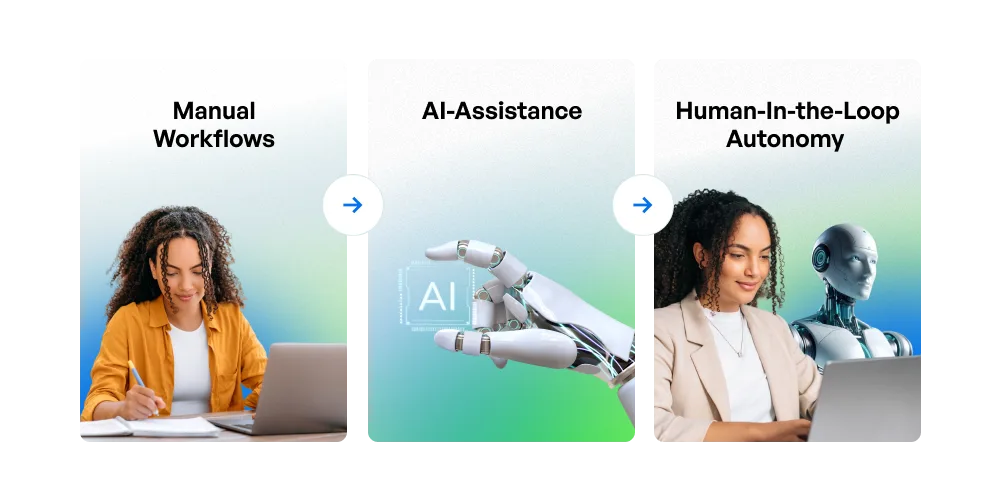
Agentic PXM represents a progression: manual workflows to AI‑assisted tasks to systems that can act autonomously across the product experience lifecycle.
Few organizations are fully there yet, and there’s a lot of progress to be made. But mindset shifts and purpose-built solutions will make the transitions easier.
Organizations that treat agentic commerce as a future problem risk locking themselves into systems that can’t scale with autonomy. Those that start laying the right foundations today will be positioned to move faster as agentic models mature.