


Foundation Completeness
Identity GTIN Brand Taxonomy Required attributes

AI Readiness Assessment
Your products can be in every catalog and still be absent from AI recommendations.
Get a structured evaluation of how ready your product data, content and processes are to be discovered, trusted and recommended by AI agents.

Your agent readiness score is a composite 0 – 100 rating across five dimensions.
Identity GTIN Brand Taxonomy Required attributes
Category specifications Claims & evidence Composition Usage Compatibility
Factual density Claim explicitness Machine interpretability
Whether claims are sourced, verified, or traceable
Whether time-sensitive attributes stay current

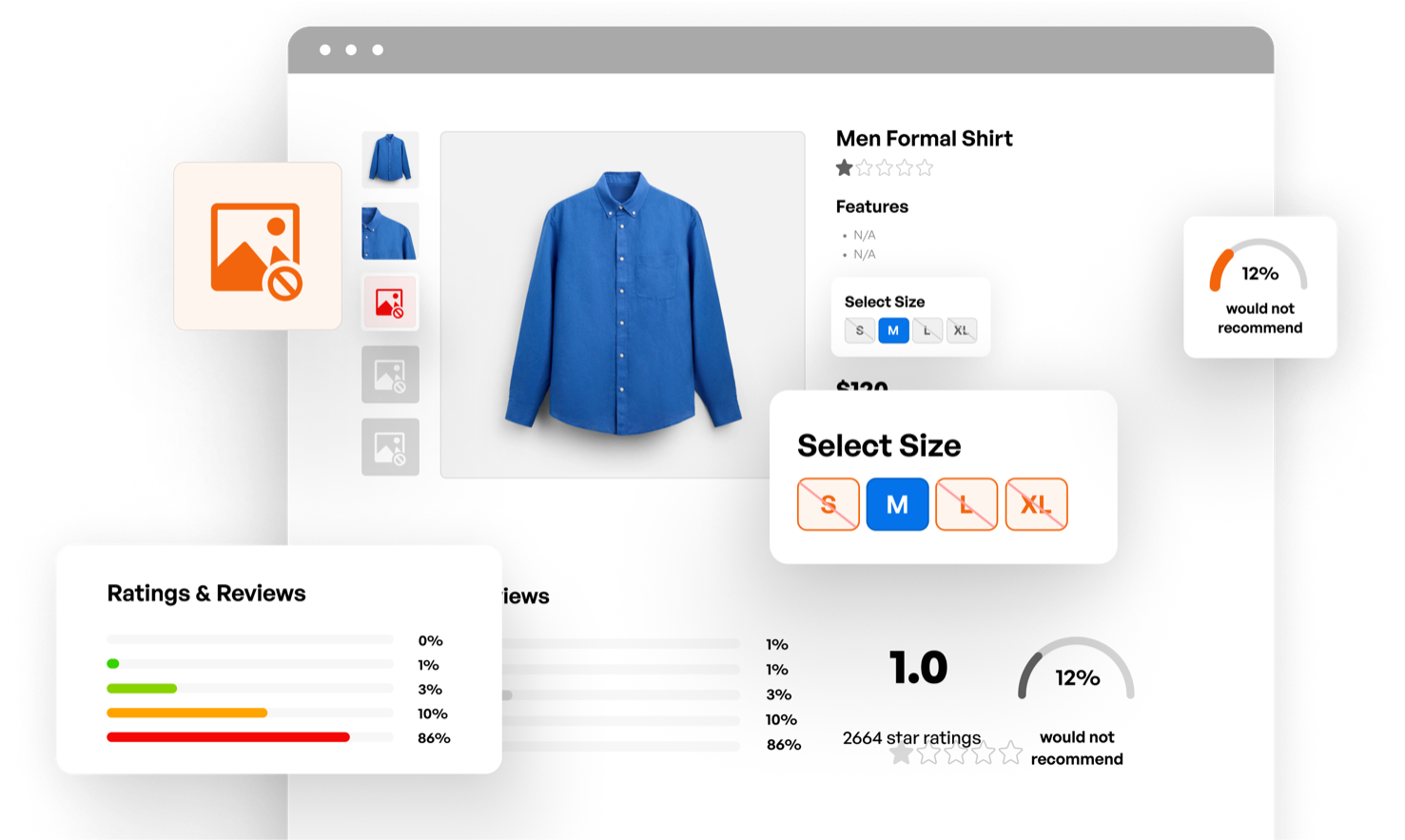




Measure your readiness for AI-driven commerce.

Uncover missing, incomplete, or untrusted product data.

Increase the likelihood your products can be discovered and recommended.

Receive a tailored roadmap for AI commerce readiness.

Product catalogs were designed for ecommerce sites, retailer syndication, and traditional search. AI shopping assistants evaluate differently.
They need:
Syndigo is your trusted partner to assess, analyze, and execute your AI-commerce readiness.
Get Your Assessment Score














The Assessment
The Syndigo AI Readiness Assessment is a structured evaluation of your product data to determine how well it supports AI-driven product discovery, recommendations, and commerce experiences. It identifies strengths, gaps, and opportunities, then provides a roadmap for improvement.
More consumers are discovering products through AI-powered search and recommendation experiences. If your product data is incomplete, unclear, or difficult for AI systems to understand, your products may be overlooked in favor of competitors with more AI-ready content.
The assessment examines the completeness, quality, structure, freshness, and trustworthiness of your product data. It also evaluates how effectively your content communicates facts and product attributes that AI systems use to understand and recommend products.
The Agent Readiness Score is a rating from 0 to 100 that measures how prepared your product data is for AI-driven discovery and recommendations. It provides a simple benchmark you can use to understand your current state and track improvement over time.
Not exactly. GEO (Generative Engine Optimization) focuses on improving visibility within AI-powered search and answer engines. AI readiness is broader, evaluating the underlying product data that AI systems need to confidently understand, recommend, and surface your products.
SEO and digital shelf strategies were designed primarily for search engines and online storefronts. AI systems rely more heavily on structured, complete, trustworthy product data and may interpret information differently than traditional search algorithms.
The Process
The timeline depends on the scope and size of your catalog, but a standard assessment is typically completed in approximately 2-6 weeks. Shorter engagements are also available for organizations seeking an initial benchmark.
Most assessments require access to product content sources such as PIM, DAM, or syndication feeds, along with a small number of working sessions to align on goals and review findings. Our team handles the analysis and reporting.
Yes. The assessment uses a consistent methodology and scoring framework designed to evaluate product data quality and AI readiness, regardless of the technology solutions you currently use. The results are intended to provide an objective view of your data readiness.
Rather than reviewing every SKU, the assessment uses a representative sample of your catalog. The sample includes top-performing products, key categories, and a selection of long-tail products to provide a reliable view of overall readiness.
The Outcome
You will receive an Agent Readiness Score, a detailed analysis of product data gaps, category-level findings, and a prioritized roadmap for improvement. All results are presented in an executive-friendly format designed to support business and investment decisions.
Your report becomes a baseline for future improvement efforts. You can use the findings to prioritize initiatives, align teams, and create a data strategy that improves AI visibility, discoverability, and recommendation performance over time.
The assessment identifies the specific data gaps that may prevent AI systems from understanding or recommending your products. By addressing those gaps, you can improve how your products are surfaced, evaluated, and recommended across emerging AI-powered shopping and discovery experiences.