

A shopper opens an AI assistant, describes what they want, and gets back three products to consider, not a search results page to scroll through. That shortlist is quickly becoming where the buying decision happens: AI-referred traffic to U.S. retail sites grew 393% year over year in Q1 2026, and those visitors convert 42% better than traffic arriving from paid search or email.
For a CMO or VP of ecommerce watching recurring revenue, that’s a channel worth taking seriously. It’s also a channel most product pages were never built to be judged by.
Shoppers have moved faster than product pages have
The shift goes beyond traffic numbers. 83% of consumers used an AI tool in the past six months, 43% specifically to shop, and 18% say they’ve already replaced traditional search with an AI assistant. That’s a real change in where people start looking, not a habit confined to a handful of early adopters.
Most ecommerce and merchandising teams have spent years building what used to win this moment: strong product pages backed by high ratings and deep review coverage. That work still counts for the shopper who reaches the page. The trouble is what happens before they get there, when an AI agent is doing the evaluating instead.
The reviews are there. The AI never sees them.
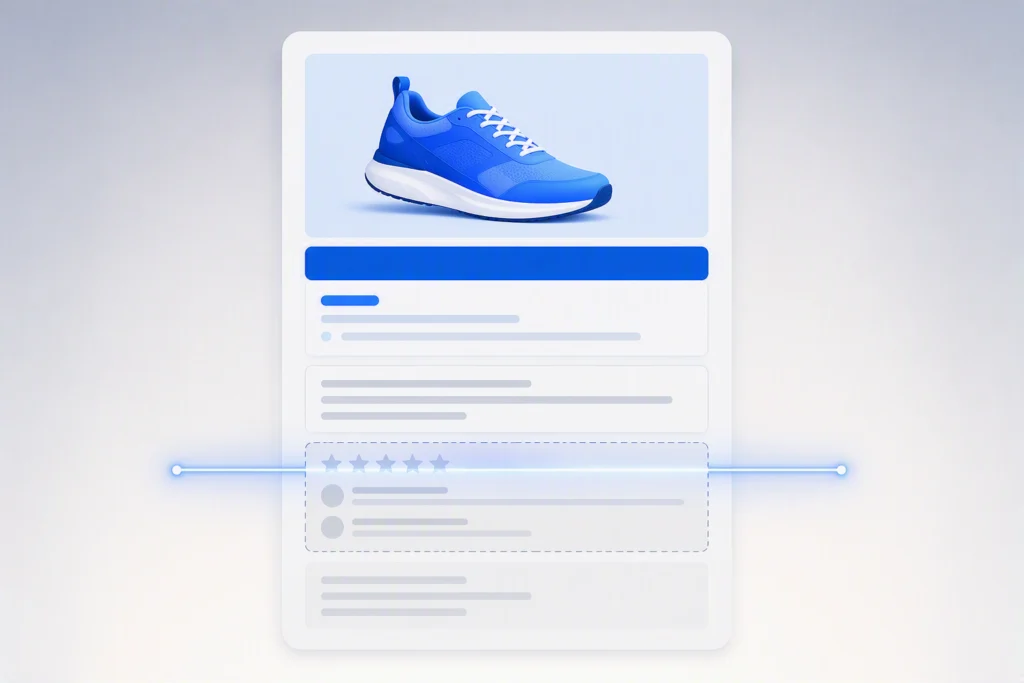
Here’s the mechanism. Most review widgets load in the browser: the page arrives, then JavaScript fetches the star ratings and written reviews and drops them into place. A shopper sees all of it. An AI agent reading the same page usually can’t, because most AI agents work from the raw HTML a server sends and generally don’t execute the JavaScript that would fill in the review container afterward. What the server actually delivers is product details and an empty box where the reviews belong.
A quick way to check this: pull up the page source on a bestselling product page and search for the star rating or the review count. If it’s not sitting there in the raw HTML, an AI agent reading that page isn’t finding it either, even while a shopper scrolling the same page sees it clearly.
The gap carries a measurable cost. AI agents are 20% to 40% less likely to select a product when information like review sentiment or review volume is missing from what they can read. A product with thousands of verified five-star reviews and a product with none can look identical to an AI agent, because neither one’s reviews make it into the evaluation.
That’s a strange place for a brand’s strongest trust asset to go quiet. Reviews are the evidence that used to separate a considered product from an ignored one on the page. Losing them right as AI assembles its shortlist means competing on price and spec sheet alone, without the one thing most likely to tip a close call.
The fix is a server-side implementation, not a new review program
PowerReviews GEO provides a defined server-side approach for making existing PowerReviews content available in a product page’s initial HTML response. Using the PowerReviews Display API, a brand’s development team can publish Product, AggregateRating, and Review structured data within the PDP source, so crawlers and AI systems that may not execute JavaScript can access the same ratings and review content shown to shoppers.
The shopper-facing experience stays put. The existing review collection and moderation process doesn’t change, and neither does the interactive display shoppers see. What changes is what’s present the moment a machine requests the page instead of a browser. There’s nothing new to collect or write, and nothing to purchase, to make it work.
Verify the work yourself
PowerReviews GEO makes the content readable, and it stops there on purpose. Independent testing has found that query-level AI-visibility tracking is unreliable. The same question can return different results depending on which model answers and when it’s asked, even within the same session.
What a brand can verify is more modest and more solid: reviews sitting in the page’s view source, and structured data that validates on a refresh cadence that runs on schedule. Those are facts a team can confirm directly, without taking anyone’s black box on faith.
Crawlability is becoming table stakes, and most review platforms will eventually publish some version of this. What keeps mattering after that is whose review data AI systems trust enough to cite. That’s not just a publishing problem, it’s a verification one: reviews that have passed fraud and authenticity checks carry different weight than reviews that haven’t, and that distinction is what AI systems will eventually have to sort out too. Before crediting SEO, check if your review content is something an AI agent can read.
To see whether your own product pages read the same way to an AI agent as they do to a shopper, talk to your PowerReviews team about GEO.