

Article 4 of 5 in the State of Product Experience 2026 Collection
For decades, discounts have been one of retail’s most reliable levers. Lower the price, add a promotion, and give shoppers a reason to act now.
That still works. Shoppers have not suddenly stopped caring about price. But the latest State of Product Experience research suggests that something else now carries even more weight at the moment of choice: what other customers have to say.
Among online shoppers surveyed for The State of Product Experience 2026, 53% named ratings and reviews as one of their top three purchase considerations. That narrowly beat out detailed product descriptions at 52%, followed by discounts at 49%.
Shoppers are looking for proof, not simply a lower price
A discount can make a product more attractive. It cannot tell shoppers whether the product works, fits, tastes, looks, or performs the way they expect.
Reviews can.
They give shoppers access to the details that rarely fit neatly into a product description: whether an appliance is louder than expected, a shirt runs small, an assembly process is frustrating, or a product holds up after months of use. They turn someone else’s experience into evidence that helps the next shopper make a more confident decision.
The findings should not be read as “price no longer matters.” They point to something more interesting: shoppers increasingly evaluate value through proof as well as price. A markdown can lower the financial cost of choosing. Reviews can lower the uncertainty.
And in an environment of nearly endless options, reducing uncertainty may be the more powerful lever.
The broader research tells a similar story
The finding is consistent with other consumer research. In a 2026 survey of 2,000 Americans, ConsumerAffairs found that 77% considered online reviews important and one in three would not make a purchase without reading them first. About 80% said reviews had influenced them to avoid buying a product or service.
PowerReviews research has also found that ratings and reviews can outrank price, free shipping, brand preference, and recommendations from family and friends as an influence on online purchase decisions. That study further showed that shoppers pay attention to more than the average score: the content, volume, and recency of reviews all affect how much confidence they place in what they see.
In other words, having a star rating is not the same as having a strong review experience. Shoppers want enough recent, credible detail to understand why customers rated a product the way they did.
Reviews do something discounts cannot
Discounting can generate attention and accelerate demand, but it comes with an obvious cost: margin. Reviews work differently. They build confidence around the product’s value without requiring the brand to reduce that value at checkout. It makes them part of the value equation.
For brands and retailers, the opportunity is to treat reviews as core product content rather than a secondary module near the bottom of the page. That means:
- Building review collection into the post-purchase experience
- Syndicating reviews so shoppers can find them wherever they evaluate a product
- Making recent, verified feedback easy to identify
- Pairing ratings with written, visual, and video content that explains the customer experience
- Using review themes to improve product descriptions, imagery, FAQs, and the products themselves
Critically for brands, retailers, and marketplaces, reviews can drive a purchase decision without hurting margins. And while a discount might win one sale in the moment, a review is evergreen and can motivate purchases indefinitely.
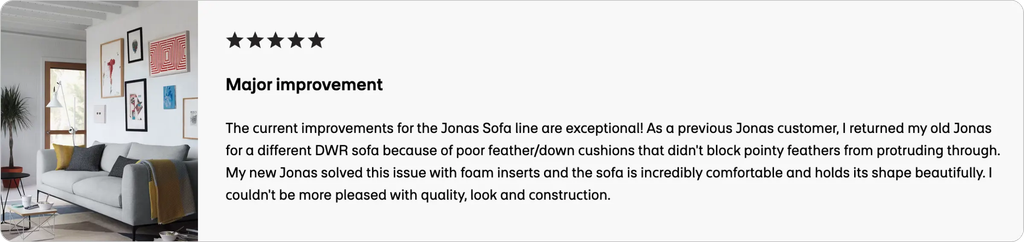
For premium furniture manufacturer MillerKnoll, reviews help shoppers feel more confident making high-consideration purchases. The company partnered with PowerReviews to expand authentic customer feedback across a catalog of more than 153,000 SKUs. The impact was significant: shoppers who engaged with reviews converted at a 350% higher rate, while those who interacted with customer Q&A converted at an even higher rate. The complete story explores how MillerKnoll scaled its program—and turned customer feedback into measurable growth.
Confidence may be the best promotion
Discounts remain powerful, especially when shoppers are price-sensitive or comparing similar products.
But price alone does not resolve the questions that make someone hesitate. Reviews can.
Brands that answer that second question with abundant, authentic, and useful customer proof may not have to rely quite so heavily on the first.
Previously in this collection: Shopping choice drivers are weirdly similar around the world (until they’re not)
Next in this collection: How AI changes the product-information job—and why the fundamentals still win.