

This blog was written by Tarun Chandrasekhar, President & Chief Product Officer at Syndigo.

Two things are true about this holiday season, and most retailers are treating them as separate problems.
The first: tariffs have pulled sourcing and assortment decisions forward by weeks. Buyers who used to finalize holiday assortments in October are locking them in by early September, in two-week windows instead of month-long ones. The goal is predictability, not optimization. Lock in known costs before the next macro shift changes the math again.
The second: shoppers are increasingly deciding what’s “in stock” before they ever open a retailer’s app. They’re asking ChatGPT or Gemini to compare products, prices, and availability first. The store visit, if it happens at all, comes after the decision is already half made.
AI shopping is colliding with the tariff impact.
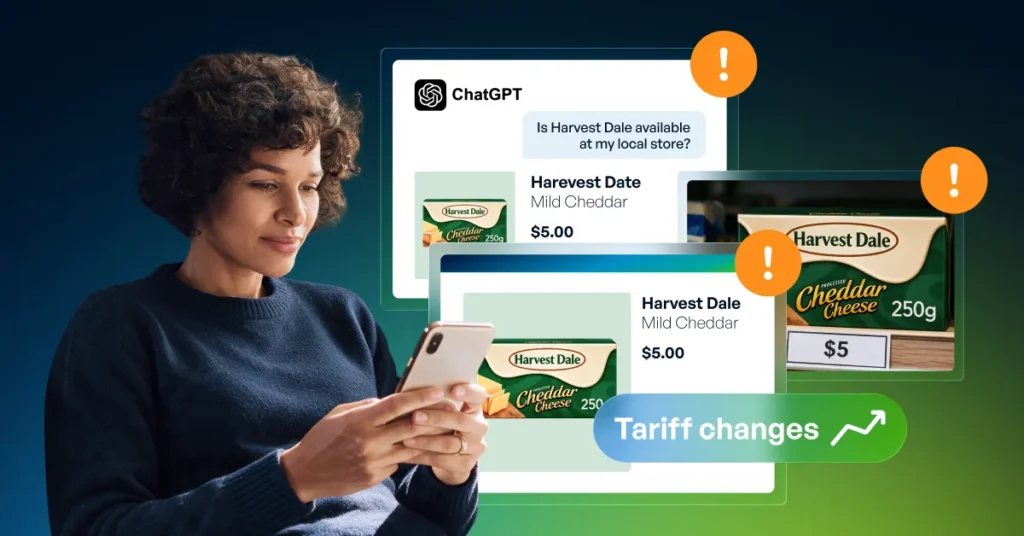
Here’s what that collision actually looks like. A retailer facing tariff pressure on a cheese import swaps suppliers to hold price. That’s a reasonable, defensible decision. But the product page, the marketplace listing, the shelf label, and the AI assistant’s index of that retailer’s catalog don’t update on the same clock as the sourcing decision. For a window that can stretch to weeks, the assortment has changed and the data hasn’t caught up.
In a browse-and-decide-later world, that gap was tolerable. In an ask-an-AI-first world, it isn’t. If a shopper asks Gemini whether a product is available at a given price and the answer is wrong because the underlying data is stale, that shopper doesn’t correct the record. They go to a competitor. They never walk into the store to find out the answer was outdated.
Grocery and food are feeling this hardest, for a simple reason: regulatory complexity. Country-of-origin rules and allergen compliance make supplier swaps slower and riskier than in categories like apparel, which already has assortment-change muscle from decades of seasonal cycles. A narrower, faster-changing assortment paired with a slower-changing compliance process is exactly where the data lag gets worst.
Retailers know this, which is why many are doubling down on loyalty programs and retailer-owned AI shopping assistants. Both are attempts to keep the customer relationship inside their own ecosystem rather than losing it to a third-party AI referral. That’s a sound defensive move. But it doesn’t fix the underlying problem if the assistant is drawing on the same stale product data as everything else.
If you’re responsible for product content this quarter, here’s the question worth asking before the next sourcing decision gets made: how long is the gap between when an assortment changes and when every surface that describes it, PDP, marketplace listing, AI assistant index, reflects that change? If you don’t know the answer, that’s the number to find.
The tariff cost is temporary. It shows up on a cost line and eventually goes away. The trust cost of a shopper who asked an AI assistant, got a wrong answer, and quietly went elsewhere does not show up on a line item, and it lasts considerably longer than the tariff that caused it.
Retailers are, understandably, focused on supply chain execution right now. The ones who also treat product data synchronization as part of that execution, not a separate workstream, are the ones who’ll keep the customer relationship this AI-first shoppers are already starting to route around them.