


This blog was written by Tarun Chandrasekhar, President & Chief Product Officer at Syndigo.

Shoptalk Spring 2026 closed its doors in Las Vegas last week with a clear thesis dominating every stage, every hallway conversation, and every cocktail-hour debate: agentic commerce is the future of retail.
AI agents acting on behalf of consumers – discovering products, comparing options, completing purchases – captured the imagination and dominated the conversation of every brand, retailer, and technology provider at the event.
There was just one problem nobody wanted to say out loud. The infrastructure to make agentic commerce real doesn’t exist yet. And the most critical missing piece isn’t the AI.
It’s the product data.
We’ve spent years building the data infrastructure layer that modern commerce runs on: establishing and strengthening brand-retailer connections, forging the world’s largest and most powerful GDSN data pool, building vast libraries of validated product content available on demand, and making it easier for firms to store, manage, share and update content across the product lifecycle. What we heard at Shoptalk confirmed what we’ve always believed: complete, structured, syndicated product data isn’t a back-office concern. It’s the foundation that everything else – every AI model, every agent, every channel – depends on.
The Agentic Promise – and the Infrastructure Gap
The most anticipated keynote at Shoptalk was titled ‘Sorting Agentic Hype from Reality,’ delivered by Bret Taylor, Co-Founder of Sierra and Chairman of OpenAI. The title itself said everything about where the industry is: excited, but honest about the distance between the vision and the reality.
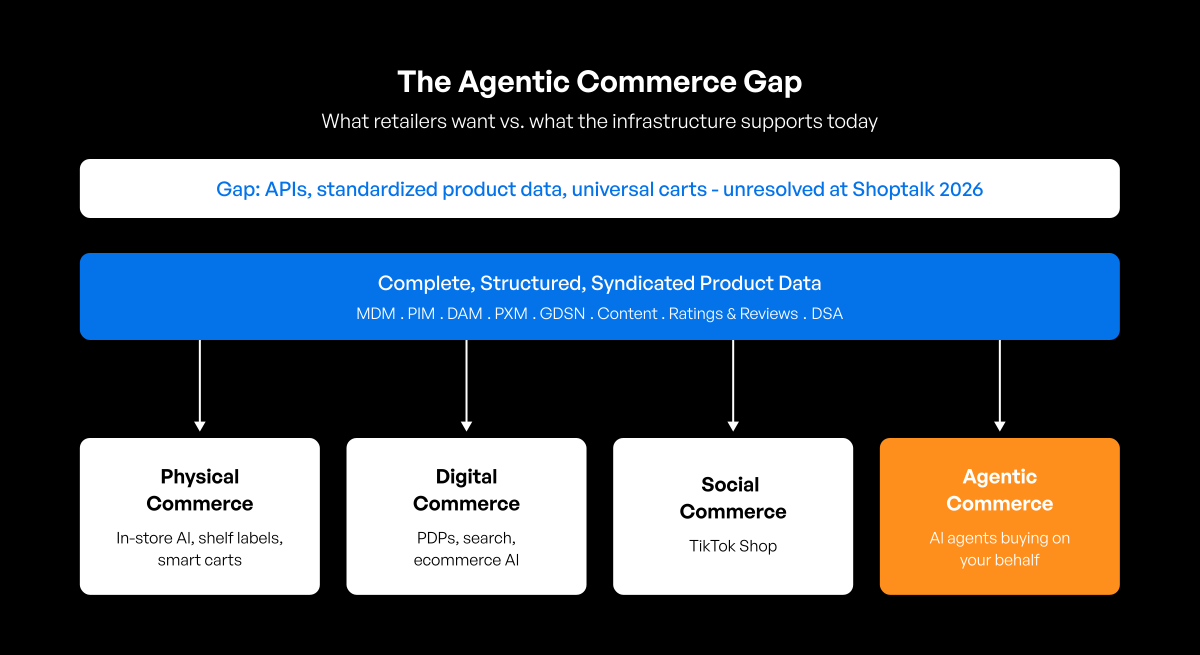
Agentic commerce – where AI agents proactively manage shopping on behalf of consumers – stood out as the most exciting-yet-infrastructure-challenged opportunity at the show. Three specific gaps were called out repeatedly throughout the conference:
- Universal APIs: retailers and brands don’t yet share a common interface that agents can reliably transact across.
- Multi-merchant cart capabilities: an agent shopping across multiple retailers can’t yet consolidate a purchase in a single action.
- Standardized product data: the attribute depth, structure, and consistency needed for AI to reason about products simply isn’t there at scale.
The first two gaps are infrastructure challenges that the industry will solve over time with new technology.
The third gap – product data – is the one that has been quietly building for decades. And it’s one that can’t simply be innovated out of with point solutions; it requires a comprehensive base of tools, relationships, policies, processes and talent that can only be found in one place.
Discovery Has Changed. Data Requirements Haven’t Caught Up.
A packed session featuring Sephora and OpenAI delivered one of the clearest articulations of what agentic commerce actually demands from product data.
The core insight: more than half of queries on AI platforms today are not direct product searches. They are problem-led, contextual, and constrained by personal preferences. A shopper no longer types ‘moisturizer SPF 30.’ They ask: I have sensitive, combination skin, I’m traveling to a humid climate next week, I need something that layers under makeup and won’t pill. What should I use?
For an AI agent to answer that question – and answer it correctly – it needs product data that goes far beyond a title, a few bullet points, and a hero image. It needs:
- Full ingredient and composition data
- Skin type compatibility attributes
- Climate and use-case metadata
- Format and texture classifications
- Layering and compatibility information
- Verified ratings and reviews for social proof
- Real-time availability and pricing
And importantly, all this data needs to be accessible, structured, and machine-readable. If it’s hidden away or in a silo or formatted such that an LLM can’t easily parse and interpret it, the product might as well be invisible to AI.
This is the new baseline for product content. And it requires brands and retailers to fundamentally rethink their approach to their product data infrastructure.
GEO Is Creating a New Demand for Data That Never Made It to the PDP
One of the quieter but most significant trends at Shoptalk was the emergence of generative engine optimization (GEO) as a serious strategic concern.
As AI-powered search – think ChatGPT, Perplexity, or Google’s AI Overviews – increasingly mediates product discovery, the rules for how products get surfaced are changing.
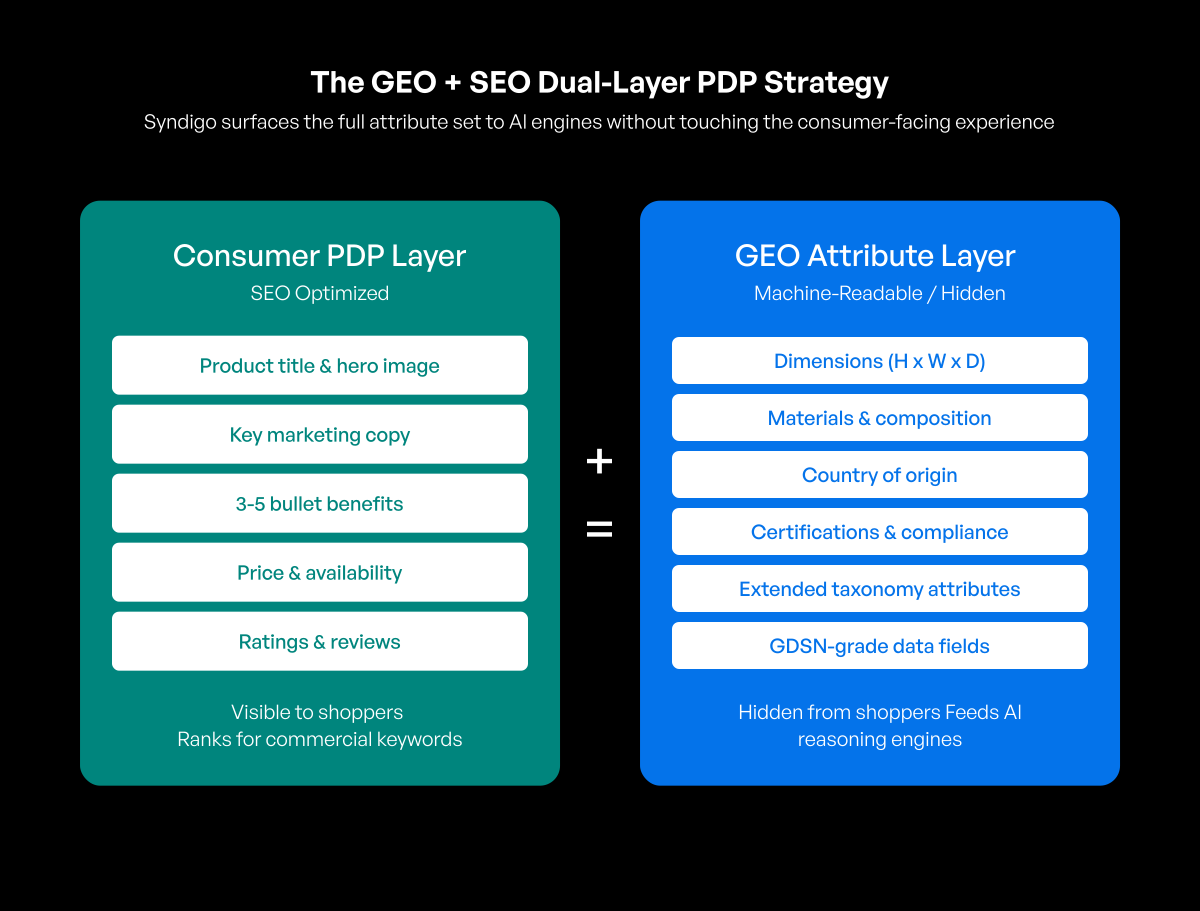
Traditional SEO rewarded clean, keyword-optimized product pages. GEO rewards something different: depth of reasoning-grade product data. And the attributes that support AI reasoning are often the exact attributes that were historically omitted from PDPs to keep them clean and light.
- Dimensions: exact height, width, depth, and weight – not just ‘compact size.’
- Materials and composition: full ingredient lists, material breakdowns, fabric percentages.
- Country of origin: increasingly important for both AI reasoning and regulatory compliance.
- Certifications and compliance: organic, fair trade, cruelty-free, sustainability claims.
- Extended taxonomy attributes: the hundreds of category-specific fields that GDSN and retail data standards have always required but brands rarely surfaced publicly.
Here’s the challenge: adding all of this data directly to the consumer-facing PDP risks diluting the experience, increasing page weight, and disrupting the SEO signal that’s already working.
But there’s a special approach, one that Syndigo has mastered, that solves this problem cleanly.
By embedding GEO-grade attributes in machine-readable but visually hidden portions of the PDP, we allow brands to maintain their polished consumer experience while giving AI engines the full attribute depth they need to reason accurately about products.
The shopper sees a clean page. The AI sees the complete data set. Both get what they need.
This is the dual-layer content strategy that the age of agentic commerce requires – and it’s only possible if you have the data infrastructure to produce and manage that attribute depth in the first place.
The Only Platform That Can Bridge the Gap
Agentic commerce doesn’t care about organizational silos.
An AI agent deciding whether to recommend your product doesn’t separate your PIM data from your DAM assets from your ratings content from your GDSN feed.
It sees – or fails to see – one complete product signal.
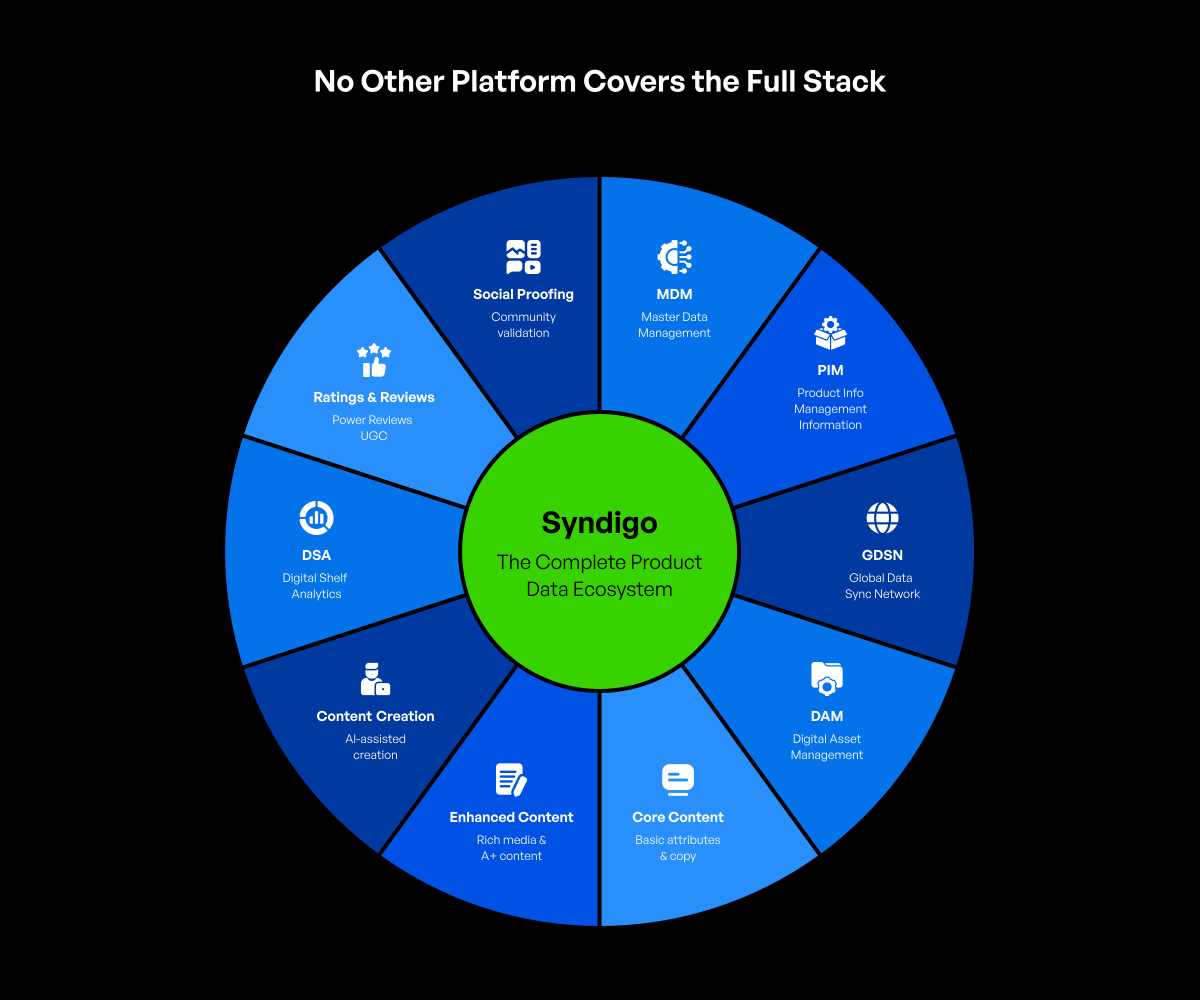
The inconvenient reality for most brands is that their product data lives in fragmented systems, managed by different teams, inconsistently maintained, and rarely synchronized. That fragmentation is exactly what prevents agentic commerce from working. For success on the new frontier of commerce, multiple pillars of data, signals, and product experience all need to come together in sync:
Data Foundation
- MDM (Master Data Management): the single source of truth for enterprise product and multi-domain data.
- PIM (Product Information Management): structured product attributes at scale, maintaining consistency across every channel and market.
- GDSN (Global Data Synchronization Network): the backbone of physical retail data exchange, connecting brands to retailers globally through the world’s largest data pool.
Content and Experience
- DAM (Digital Asset Management): centralized management of all rich media assets tied directly to product records.
- Core and Enhanced Content: from basic product listings to A+ content, brand stores, and interactive ecommerce media.
- Content Creation and Verification: AI-assisted content generation with human verification – ensuring accuracy, compliance, and brand consistency.
Social Proof and Trust
- Ratings and Reviews: the layer of user-generated content that consumers and AI agents increasingly depend on for product validation.
- Social Proofing: community-driven signals that, as Reddit’s CEO noted at Shoptalk, 40% of platform conversations are already commercial in nature.
Distribution and Intelligence
- PXM (Product Experience Management): orchestrating how product content is tailored and delivered across every channel and retailer requirement.
- Syndication: getting the right content to the right place, in the right format, at the right time – across 3,500+ retailers, ecommerce platforms, distributors, apps, and other recipients.
- Analytics: closing the loop with visibility into how product content is performing, what’s working, and where to optimize.
From Physical Shelf to Agentic Transations – One Data Foundation
Syndigo is the only company in the world that manages the full product data ecosystem end-to-end.
No other platform covers this stack. Some competitors contribute pieces of it. Syndigo owns the whole thing – which means we can ensure that every layer of product data is consistent, synchronized, and ready to power every commerce channel.
A product that’s properly represented in Syndigo’s ecosystem shows up in all four commerce channels that dominated Shoptalk conversations – physical, digital, social, and agentic:
- Physical commerce: accurate GDSN data feeds planogram systems, shelf labels, supply chain operations, and in-store AI applications at retailers like Walmart and Kroger.
- Digital commerce: optimized PXM content drives PDP performance, search ranking, and conversion across Amazon, Target, and thousands of other retail destinations.
- Social commerce: enhanced content and rich media assets, paired with verified ratings and reviews, perform in TikTok Shop and Instagram environments where 74% of Gen Z is now discovering products.
- Agentic commerce: the full attribute depth – MDM-grade data, GEO attributes, social proof signals – gives AI agents the complete product intelligence they need to recommend, compare, and transact confidently.
This is not a theoretical future state; it’s what Syndigo is doing today for 15,000+ brands connecting to 3,500+ retailers.
The difference is that as agentic commerce scales, the brands already running on complete product data will be the ones that immediately show up in AI-mediated purchase decisions today and tomorrow. The ones that aren’t will be invisible.
The Window Is Wide Open – But It Won’t Stay That Way
Shoptalk 2026 made one thing clear: the retail industry has embraced the coming agentic commerce is coming.
The conversation is no longer about if; but how fast, what the infrastructure will look like, and who will be positioned to win.
There is a brief window open now for early adopters to get in and cement their position as leaders in agentic commerce and the preferred choices for AI and its users moving forward.
The brands and retailers that use this window to get their product data right – complete, consistent, structured, and synchronized – will be the ones whose products AI agents can confidently recommend.
The ones that don’t will face the same challenge that plagued early e-commerce: invisible on the shelf that matters most. The path to agentic commerce runs through product data. And no company has built more of that path than Syndigo.
If you want to understand how your product data strategy maps to the agentic commerce opportunity – across physical, digital, social, and AI-mediated channels – we’d like to have that conversation.
Get your copy of AI Driven Strategies for the Next Era of Retail now.